
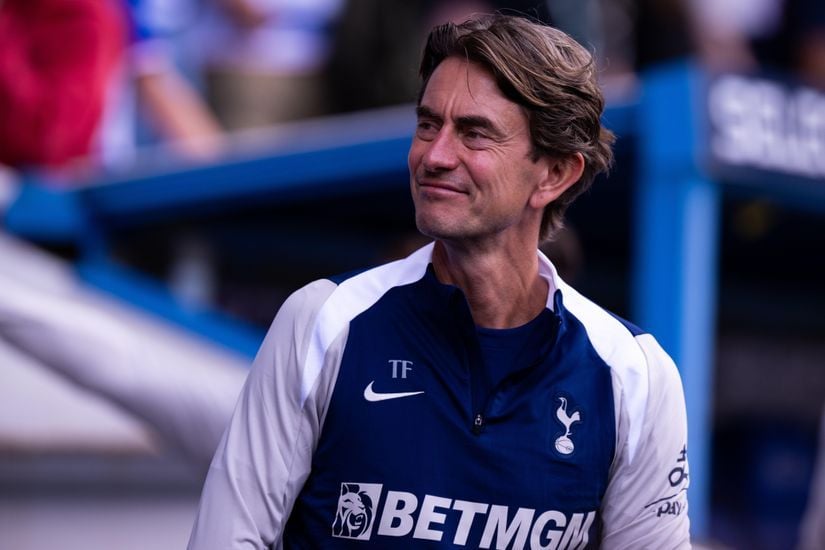
Source: Alamy Stock Photo
Tottenham Dismiss Thomas Frank After Eight-Month Tenure Ends in Turmoil
Tottenham Hotspur have parted company with head coach Thomas Frank after fewer than eight months in charge, bringing a swift end to a tenure derailed by domestic inconsistency and mounting pressure in north London.
The decision followed Tuesday’s 2–1 home defeat to Newcastle United, a result that left Spurs languishing in 16th place in the Premier League, just five points above the relegation zone. The loss extended their winless league run to eight matches — the club’s longest such sequence since 2008 — and ultimately convinced the board that a change in direction was unavoidable.
In an official statement, Tottenham acknowledged they had intended to provide Frank with the necessary backing to build a long-term project after his appointment last June on a contract running until 2028. However, a sustained downturn in league results forced a reassessment. The club expressed gratitude for the Dane’s professionalism and commitment but concluded that immediate action was required to arrest the slide.
League Form Undermines European Promise
Frank’s record in the Premier League paints a troubling picture. From 26 matches, Spurs collected only 29 points, averaging just over a point per game. They managed seven wins, eight draws and 11 defeats, with only two victories coming across their last 17 league fixtures. Home form proved particularly damaging: just 10 points from 13 matches at the Tottenham Hotspur Stadium, where frustration increasingly spilled over from the stands.
Supporters voiced their discontent in recent weeks, notably during defeats to West Ham and Newcastle, while chants calling for managerial change were audible during a draw at Burnley. Even a spirited 2–2 comeback against Manchester City — achieved after trailing by two goals at half-time — did little to shift the broader narrative of decline.
Yet the domestic gloom contrasted sharply with Spurs’ European campaign. Competing in the revamped UEFA Champions League format, Tottenham secured automatic qualification for the round of 16 after finishing fourth in the league phase. They won five of their eight matches, scoring 17 goals and conceding just seven, while registering six clean sheets — one of the strongest defensive returns in the competition to date. Their only defeat came away to holders Paris Saint-Germain.
That continental resilience, however, could not mask setbacks on other fronts. Spurs were eliminated from the Carabao Cup in the fourth round by Newcastle and exited the FA Cup at the first hurdle, falling 2–1 to Aston Villa. For a club that began the campaign by contesting the UEFA Super Cup — courtesy of last season’s Europa League triumph under Ange Postecoglou — the regression was stark.
Injuries, Suspensions and Internal Frustration
Frank’s tenure was complicated by a relentless injury list that stripped the squad of continuity. Key figures including James Maddison, Rodrigo Bentancur, Richarlison, Dejan Kulusevski and Lucas Bergvall endured extended spells on the sidelines, while defensive options Ben Davies and Destiny Udogie were also unavailable during critical periods.
Captain Cristian Romero publicly criticised the club’s squad depth earlier this month, describing it as “disgraceful” that only 11 senior players were fit for a league encounter against Manchester City. The Argentine defender later compounded matters by receiving his second red card of the season in a defeat to Manchester United, ruling him out of three forthcoming league matches — including the impending north London derby against Arsenal.
Despite those mitigating factors, Tottenham’s defensive frailties and lack of cutting edge in domestic fixtures proved decisive. Heavy defeats to Arsenal and Nottingham Forest during the winter months eroded confidence, while the inability to convert promising performances into consistent results ultimately cost Frank his position.
A Brief and Unsettled Chapter
Frank arrived in north London with a strong reputation after seven years at Brentford, where he guided the club from the Championship to the Premier League and established them as a competitive top-flight side. His appointment was viewed as a progressive move, aimed at blending tactical structure with long-term development.
The campaign began encouragingly, with victories over Burnley, Manchester City and West Ham in the opening weeks, alongside a Champions League triumph against Villarreal. But momentum faded rapidly as injuries mounted and performances flattened.
For a club that has now dismissed multiple managers in the post-Mauricio Pochettino era, the latest upheaval underscores ongoing instability at boardroom level. With a crucial derby looming and a Champions League knockout tie on the horizon, Spurs face a pivotal juncture in their season.
Tottenham’s hierarchy must now identify a successor capable of restoring domestic credibility while preserving European ambition — a delicate balancing act for a squad that has shown both vulnerability and potential in equal measure.
For the latest updates, in-depth analysis and exclusive coverage from across the football world, stay tuned to Betway Arabia sports news.
Author
BW Arabia Editorial Team - Sports Analysis UnitThe BW Arabia Editorial Team delivers expert sports analysis, match insights, and data-driven coverage across regional and global competitions.
Related articles
- Chelsea Hit Western Sydney for Six and Unveil Exciting New Talent
- Asian Champions Al-Ahli Conclude Training Camp with Fulham Draw
- Paolo Maldini Resigns as Italy Technical Director After 16 Days Amid National Team Coaching Turmoil
- William Saliba Ruled Out for Extended Spell as Arsenal Confirm Back Injury Blow