
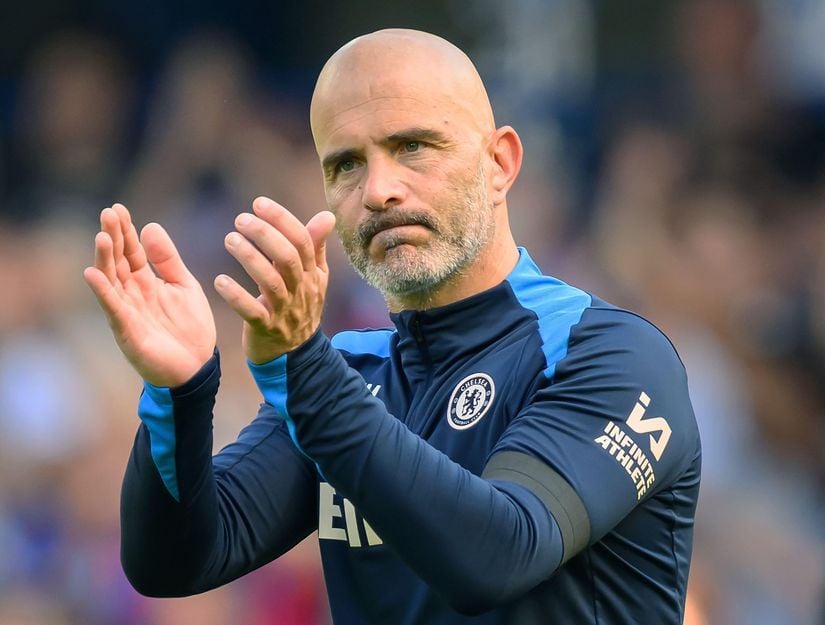
Source: Alamy Stock Photo
Not Just Results: Why Enzo Maresca Is Feeling the Heat at Chelsea
At the end of November, Chelsea appeared to be moving in the right direction. Sitting third in the Premier League and fresh from an emphatic Champions League victory over Barcelona at Stamford Bridge, the mood around west London was one of cautious optimism. A young squad seemed to be responding to Enzo Maresca’s ideas, and the club’s long-term project looked on course.
December, however, told a very different story. Just one league win across the month punctured that sense of harmony, dragging Chelsea back into the congested middle of the table. Yet results alone do not explain why Maresca has found himself under growing scrutiny. Behind the scenes, tensions have surfaced between the Italian coach and Chelsea’s hierarchy, complicating what was once viewed as a stable managerial situation.
The flashpoint came after a 2–0 home victory over Everton — Chelsea’s only Premier League win in December. Speaking publicly, Maresca referred to having endured his “worst 48 hours” since arriving at the club, hinting that “many people” were responsible. Although delivered after a solid performance, the remarks were poorly received internally. Senior figures interpreted the comments as a thinly veiled criticism of the club’s structure and communication, something they would have preferred to keep behind closed doors.
Despite the unease, Chelsea initially opted for calm reflection rather than knee-jerk action, planning a full end-of-season review. But with just one win in seven league matches, the pressure has intensified. Chelsea now sit closer to 15th place than to the top three, a statistical reality that underlines the fragility of their position. With 30 points from 19 games, the club remain fifth — still within reach of Champions League qualification — but the margin for error is shrinking fast.
January looms as a decisive month. Chelsea travel to face Manchester City without suspended midfielder Moises Caicedo, before navigating a demanding run that includes Arsenal and Napoli. Cup commitments add further complexity, with a Carabao Cup semi-final already secured and European progression hanging in the balance.
Internally, Chelsea’s leadership had been satisfied with Maresca only months earlier. Champions League qualification was viewed as a key benchmark, while success in the UEFA Conference League met expectations and the Club World Cup triumph exceeded them. Sporting directors Paul Winstanley and Laurence Stewart, alongside influential owner Behdad Eghbali, were aligned behind a strategy that prioritised youth development and long-term growth.
Maresca accepted this framework when he arrived from Leicester City in 2024, focusing primarily on coaching while the hierarchy handled recruitment, medical structures, and staffing. Chelsea’s transfer policy — assembling one of the youngest squads in Premier League history — remains unchanged. His frustration, however, is not with the quality of players but with how his work is perceived. He believes rotating a youthful squad inevitably carries short-term risk, yet feels he has not been sufficiently shielded from criticism when results falter.
The relationship has been strained further by a series of public missteps. Maresca spoke at an Italian sports festival without club approval, explored the idea of publishing a book that was ultimately blocked, and openly questioned Chelsea’s decision not to sign a centre-back after Levi Colwill suffered a serious knee injury in pre-season. Each incident, while minor in isolation, has contributed to a growing sense of disconnect.
Chelsea’s recent history offers some perspective. December has traditionally been a difficult month, with the club collecting just over half of the available points across the past seven seasons during this period. Last year, they managed only two wins between mid-December and late February. In purely footballing terms, the current downturn is not unprecedented.
What makes this spell different is the context. Results now carry greater weight because of the off-field friction. Chelsea’s January schedule — spanning four competitions, multiple London derbies, and crucial European fixtures — will likely determine whether Maresca can reassert his authority. Qualification for the 2026-27 Champions League may require as little as 1.6 points per game this season, but to reach that threshold, Chelsea need stability as much as victories.
For Maresca, the coming weeks are not just about climbing the table. They are about restoring trust, alignment, and belief that his project can still deliver on Chelsea’s long-term ambitions.
Betway Arabia continues to deliver in-depth football analysis, bringing you closer to the stories shaping the modern game.