
Source: Alamy Stock Photo
Sesko’s Surge and Lammens’ Steel Revive Manchester United’s Champions League Charge
There are moments in a season that subtly shift the narrative, and then there are moments that redefine it entirely. For Manchester United, the past fortnight has felt very much like the latter. A club that had been navigating inconsistency and scrutiny now finds itself dreaming of a return to the UEFA Champions League — thanks largely to the timely interventions of Benjamin Sesko and the composure of Senna Lammens.
Head coach Michael Carrick summed up Sesko’s development with understated clarity, noting that progress can arrive in incremental strides or dramatic leaps. In recent weeks, the Slovenian forward has chosen the latter.
United’s revival has not been built on dominance alone, but on decisive contributions in high-pressure moments. Without Sesko’s impact from the bench at West Ham earlier this month, Carrick’s men would likely have returned to Manchester empty-handed. His stoppage-time volley that night — struck with immaculate timing and technique — salvaged a point that could yet prove invaluable in a congested top-four race.
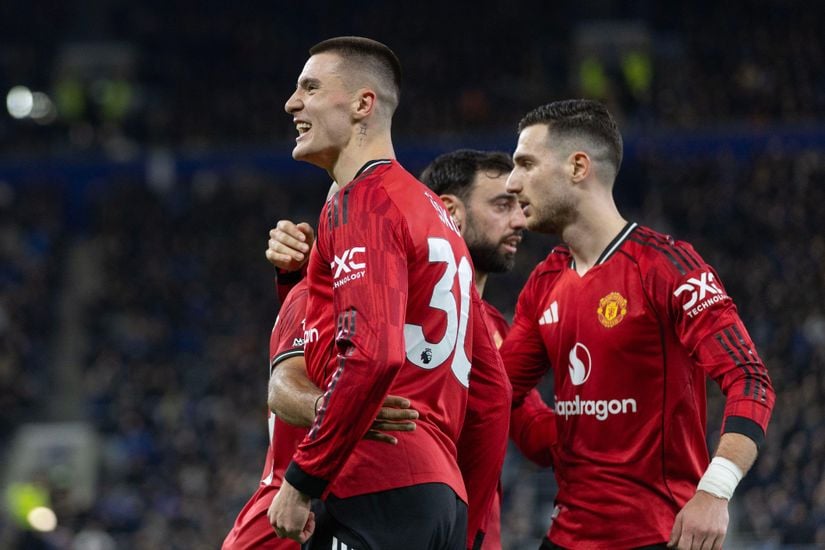
If that goal was an exhibition of finesse, his winner against Everton was an emphatic demonstration of physical and mental endurance. With the match finely poised in the 71st minute, Sesko initiated the move, surged nearly the length of the pitch at full throttle, and calmly applied the finishing touch to Bryan Mbeumo’s measured cross. It was a sequence that encapsulated both athletic power and clinical composure — the hallmarks of a forward reaching maturity.
Carrick described it as ruthless. Observers were equally impressed. The sheer distance covered before the finish — more than 70 yards at sprinting pace — made the composure of the final strike all the more remarkable. In a league where marginal gains separate qualification from disappointment, such moments carry enormous weight.
Sesko’s tally now stands at eight goals for the campaign, but the raw number tells only part of the story. Under former manager Ruben Amorim, who sanctioned his £73.7 million move from RB Leipzig last summer, the striker found the net only twice. Since the managerial change in January, his output has accelerated sharply. Six goals in his last seven appearances suggest a player liberated, more confident in his role, and increasingly decisive in decisive moments.
Statistically, United’s trajectory mirrors Sesko’s upturn. They have collected 13 points from a possible 18 under Carrick, lifting them into fourth place. The margins remain slender — three points separate them from Aston Villa above, while Chelsea and Liverpool lurk ominously just behind — but momentum has shifted.
Lammens’ contribution should not be overlooked in this resurgence. The Belgian goalkeeper has delivered consecutive assured performances, commanding his area with authority and producing key interventions that preserved narrow advantages. In tight contests where a single lapse can unravel months of work, that stability at the back has proven just as critical as Sesko’s spark in the final third.
The debate surrounding Sesko’s status — substitute weapon or starting striker — has intensified with each decisive cameo. Carrick acknowledges the discussion but refuses to be drawn into rigid hierarchies. Modern football, particularly at the elite level, demands depth and adaptability. Whether deployed from the outset or introduced in the latter stages, Sesko’s role is clear: influence outcomes.
From the player’s perspective, clarity of purpose appears to have replaced early-season uncertainty. He speaks openly of belief — not only in himself, but in the trust shared within the dressing room. That collective conviction has often been absent during United’s more turbulent periods over the past two seasons.
A return to Europe’s premier competition would represent more than financial incentive or prestige. It would symbolize tangible progress after years of managerial upheaval and transitional rebuilding. The club has not featured in the Champions League for two consecutive seasons — a rarity in its modern history — and the psychological lift of rejoining that stage cannot be overstated.
There is still work to be done. The Premier League’s final stretch is rarely forgiving, and direct confrontations with rivals will test both resilience and squad depth. Yet in Sesko’s dynamism and Lammens’ assurance, United appear to have rediscovered elements long associated with their identity: late drama, individual brilliance, and an unyielding refusal to settle for mediocrity.
For now, the dream remains within reach — no longer a distant ambition, but a realistic objective forged by decisive contributions at either end of the pitch.
Stay updated with the latest football insights and exclusive coverage at Betway Arabia Sports News.