Source: Alamy Stock Photo
How McLaren Mastered the One Battle No Team Wins Easily: Keeping Two Title Contenders United
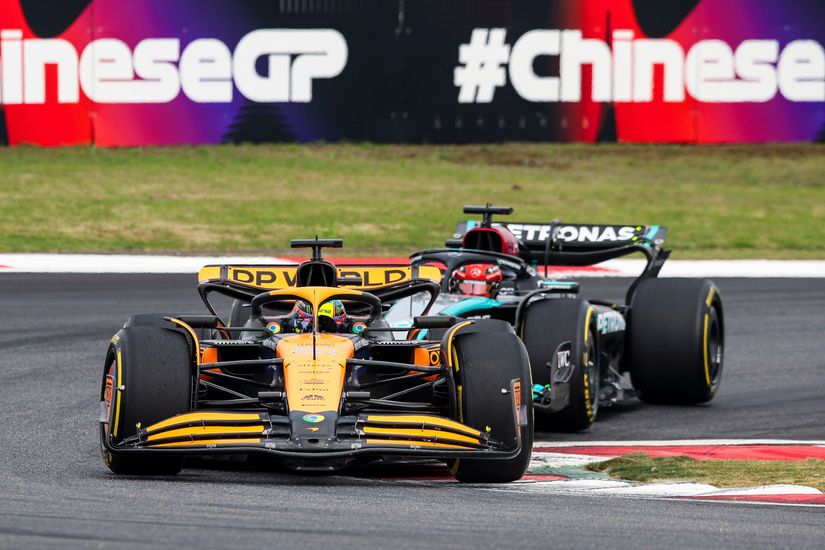
In a season dominated by McLaren’s resurgence on the track, perhaps the team’s most impressive accomplishment has taken place far from the roar of engines. While the Constructors’ Championship was wrapped up weeks ago, the extraordinary harmony between Lando Norris and Oscar Piastri—two young drivers fighting directly for the world title—has become one of the defining stories of the year.
With only two races remaining, Norris holds a 24-point advantage over Piastri and Max Verstappen, yet the atmosphere inside the team remains remarkably composed. In modern Formula 1, such a scenario rarely unfolds without tension. History is littered with rivalries that imploded from within: Senna vs. Prost in 1989, Mansell and Piquet at Williams, Hamilton and Alonso’s McLaren meltdown in 2007, the tense Vettel-Webber partnership at Red Bull, and the Hamilton-Rosberg feud that fractured Mercedes from 2014 to 2016.
What separates McLaren’s current pairing from these volatile chapters is a culture deliberately engineered long before the championship fight became a reality. Zak Brown and team principal Andrea Stella knew the dangers of pitting two evenly matched drivers—both rising talents—against each other in identical machinery. Instead of ignoring the inevitable competition, they addressed it head-on, constructing an internal philosophy built on transparency, fairness, and emotional intelligence.
Stella, drawing from decades at Ferrari and McLaren, emphasised direct communication as the only sustainable path. Nothing, he insists, should be left to unspoken assumptions—because unspoken tension eventually resurfaces when pressure mounts. His approach convinced both Norris and Piastri that trusting the team serves their long-term ambitions better than divisive intra-team warfare.
Both drivers have embraced that idea. They speak often about how pushing each other elevates McLaren’s overall performance—a philosophy reminiscent of the Hamilton-Rosberg dynamic at its best, without the political paralysis that defined that rivalry. They also understand the significance of pursuing their first championship with McLaren rather than at the expense of the team’s stability.
Yet maintaining harmony has not been without challenges. Key flashpoints—including strategy splits in Hungary, pit-stop choreography issues in Monza, wheel-to-wheel aggression in Singapore, and the sprint-race collision in Austin—could have destabilised less cohesive teams. Instead, McLaren’s leadership addressed each incident calmly behind closed doors, reinforcing the same principles every time: equal treatment, honest debriefs, and a commitment to letting both drivers race freely—so long as they avoid taking each other out.
Internally, the system works because every race weekend is followed by candid discussions with the drivers. No subject is off-limits. Every controversial moment becomes a learning exercise, not a grievance. McLaren sources insist that the culture seen publicly—respectful, measured, and unified—is genuine behind the scenes.
The drivers’ reactions reinforce that impression. Piastri has repeatedly dismissed any suggestion of bias, while Norris stresses the importance of questioning decisions without undermining trust. Brown, for his part, rejects accusations that Norris receives preferential treatment, explaining—in the case of Hungary—that strategy calls were simply logical gambles based on race circumstances.
Ultimately, McLaren’s greatest triumph this season may not be the silverware already secured, but the environment they have built: one capable of sustaining two world-class drivers battling for the same crown without descending into the chaos that has undone so many teams before.
And with both contenders still in the running heading into the final two rounds, McLaren’s cultural stability could yet prove the decisive factor in where the trophy lands.
For the latest breaking sports stories and exclusive insights, visit Betway Arabia.