
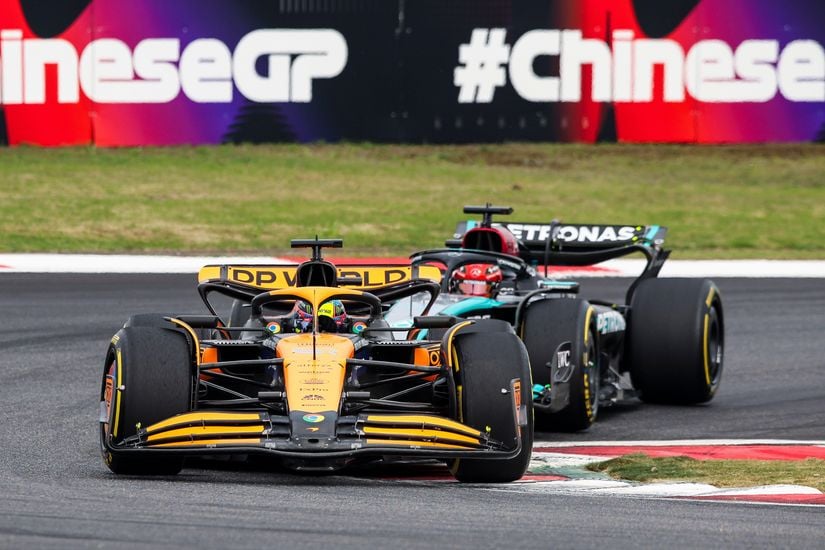
Source: Alamy Stock Photo
Qatar GP Chaos Sets Up Three-Way Abu Dhabi Title Finale as McLaren Error Hands Verstappen New Lifeline
Formula 1 heads to Abu Dhabi with its most unpredictable title showdown in more than a decade after Max Verstappen seized victory in a turbulent Qatar Grand Prix—an outcome shaped as much by Red Bull’s execution as by McLaren’s costly strategic miscalculation.
Lando Norris, who had arrived in Lusail with a 24-point cushion over both Verstappen and team-mate Oscar Piastri, saw his margin shrink to just 12 points after the team failed to pit under an early safety car. The decision, which contradicted the race logic that every other team followed, transformed a comfortable McLaren 1-2 into a strategic setback that left both drivers powerless against Verstappen’s pace.
For Piastri, the error dealt a double blow. The Australian, who had controlled the early laps with authority, watched a near-certain victory dissolve into a second-place finish. His quiet disbelief after the race said more than words—what could have been a season-defining moment had slipped away, along with his hold on second in the standings.
Norris remains in control of the championship scenario: finishing third in Abu Dhabi will secure him his maiden crown even if Verstappen wins. But the events in Qatar served as a reminder that title races are rarely won by mathematics. They are won—or lost—by decisions under pressure.
The sport has been here before. In 2010, Fernando Alonso famously surrendered what looked like an assured championship after Ferrari misjudged strategy in Abu Dhabi, allowing Sebastian Vettel to steal the title. For McLaren, the ghosts of that weekend resurfaced as the safety car on lap seven presented a straightforward call: pit and split the remaining distance into two mandatory 25-lap tyre stints, as dictated by Pirelli.
Every team made the calculation. Except McLaren.
Pitting under the safety car saves up to nine seconds compared to stopping at full pace. With overtaking notoriously difficult at Lusail, retaining track position after a late stop was virtually impossible. Verstappen understood the opportunity instantly. When he rejoined from his stop and saw both McLarens stay out, he knew the race had shifted in his favour.
Inside McLaren, the logic was more complex. Team principal Andrea Stella later admitted the team feared losing track position if rivals chose not to pit—an assumption the race quickly proved unfounded. Others in the paddock questioned whether intra-team balance also played a role. A double-stack pit stop would have delayed Norris by several seconds, dropping him behind Kimi Antonelli and Carlos Sainz. Stella did not deny this was a consideration but insisted it was not the determining factor.
Speculation that McLaren subtly favour Norris resurfaced, fuelled by earlier tactical flashpoints in Hungary and Monza. Zak Brown dismissed such theories as “nonsense” last month, reaffirming that both drivers receive equal treatment. Qatar, however, has done little to silence debate.
For Formula 1 as a spectacle, the drama could not be more timely. For the first time since 2010, three drivers arrive at the final race with a credible shot at the championship. Norris leads on 340 points, Verstappen follows with 328, and Piastri sits on 324. The momentum belongs to Verstappen, who has fought his way back from a deficit that once appeared insurmountable as he chases a fifth consecutive title.
Yet the psychological pressure weighs heaviest on McLaren. Stella, who has lived championship heartbreak and triumph—from Michael Schumacher’s early struggles at Ferrari to Kimi Räikkönen’s improbable 2007 comeback—knows how fine the margins become at this stage of the season.
His message was one of reflection, not recrimination: tough weekends build champions. Qatar, he insisted, would serve as a turning point, not a fracture.
But the stakes could not be higher. One race, 58 laps, and three contenders separated by 16 points. Abu Dhabi promises tension, unpredictability, and the possibility of a title decided as much by strategy boxes as by raw speed.
For the neutral, the finale is irresistible. For Norris, Piastri, and McLaren, it is nothing short of a test of nerve.
For more F1 news, analysis, and race-week insights, follow Betway Arabia’s dedicated sports coverage.