
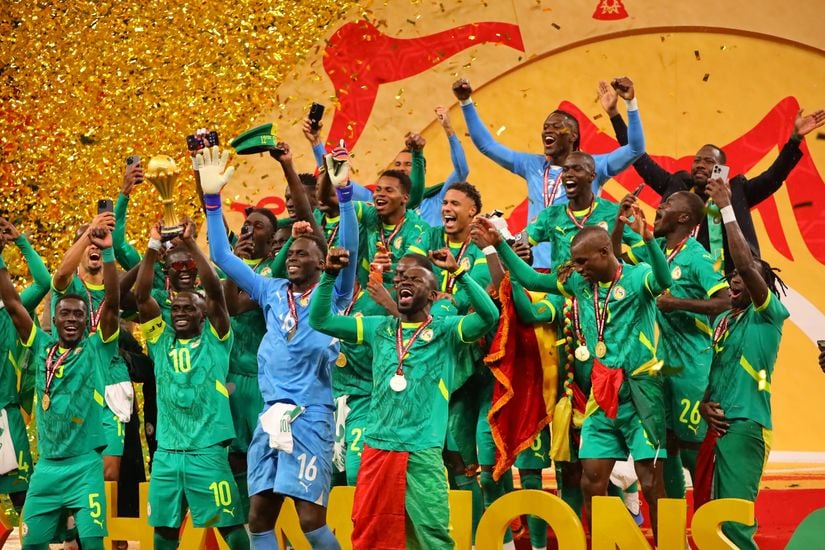
Source: Alamy Stock Photo
A stormy final crowns Senegal African champions at Morocco’s expense
A long and highly charged football night unfolded in the Moroccan capital Rabat, at the end of which Senegal were crowned champions of the Africa Cup of Nations for the second time in their history, after edging hosts Morocco to a hard-fought and valuable 1–0 victory in the final. The match was marked by excitement, controversy, and chaos, and extended into extra time after the regulation 90 minutes ended in a goalless draw.
Senegal’s title-winning goal came at the start of the first extra-time period, when Villarreal midfielder Pape Gueye capitalized on a counter-attack, unleashing a powerful shot that found the Moroccan net and handed the “Lions of Teranga” the decisive goal in a breathless contest that lasted until the final whistle.
Chaos, withdrawal, and return
The match was not short of tension, particularly in the closing minutes of regular time, when play was halted for nearly 14 minutes amid unprecedented chaos. The referee awarded Morocco a penalty after consulting the video assistant referee, a decision that sparked fierce protests from the Senegalese bench and players.
Senegal coach Pape Thiaw instructed his players to leave the pitch in protest, with some standing by the touchline while others headed towards the dressing rooms, before star man Sadio Mané intervened and persuaded his teammates to return and complete the match.
After play resumed, Ibrahim Díaz stepped up to take the penalty, but struck a strangely weak effort straight into the hands of goalkeeper Édouard Mendy, who gathered it with ease, sending the match into extra time, where Senegal ultimately prevailed.
Morocco were awarded the Fair Play Prize, while Yassine Bounou was named Best Goalkeeper of the tournament. Díaz finished as the tournament’s top scorer, and Senegal “legend” Sadio Mané was crowned Player of the Tournament.
Disappointment and a bright future
Morocco head coach Walid Regragui expressed his deep disappointment after the match, pointing to the missed penalty in the dying moments as the key turning point of the final. He said frustration had taken hold of everyone, while stressing that football can sometimes be cruel, and that the Moroccan national team would return stronger in the future. He also congratulated Senegal on their victory, while regretting the scenes that unfolded in the closing stages of the match.
Despite the final defeat and the wave of disappointment among the supporters, the broader picture confirms that Moroccan football is experiencing an unprecedented golden era in its history — one marked by major achievements at both continental and global levels, and which has made Morocco a model to be emulated in planning and sports investment across Africa.
At the 2022 World Cup in Qatar, the Moroccan national team etched its name in gold in World Cup history by becoming the first African team ever to reach the semi-finals of the tournament. This historic achievement did not come by chance, but was the result of long-term cumulative work, embodied in the elimination of traditional powerhouses such as Spain and Portugal, in a run that dazzled the world and confirmed that African football is capable of competing with the global elite when clear vision and proper infrastructure are in place.
Morocco’s excellence has not been limited to the senior national team alone, but has extended across various age groups. In October of last year, Morocco’s under-20 team was crowned world champions after defeating Argentina, one of the giants of world football. This achievement reflected the quality of grassroots development, the effectiveness of football academies, and the ability of Moroccan football to consistently produce generations of talented players capable of competing at the highest levels.
Author
BW Arabia Editorial Team - Sports Analysis UnitThe BW Arabia Editorial Team delivers expert sports analysis, match insights, and data-driven coverage across regional and global competitions.
Related articles
- Chelsea Hit Western Sydney for Six and Unveil Exciting New Talent
- Asian Champions Al-Ahli Conclude Training Camp with Fulham Draw
- Paolo Maldini Resigns as Italy Technical Director After 16 Days Amid National Team Coaching Turmoil
- William Saliba Ruled Out for Extended Spell as Arsenal Confirm Back Injury Blow